

Ohio Champion Trees in the Delaware County and Lewis Center area are unusually large examples of their species, measured through a formal tree scoring system. The area around Lewis Center also contains mature forests, river corridors, and protected parks where exceptionally large trees can grow.
What Are Ohio Champion Trees?
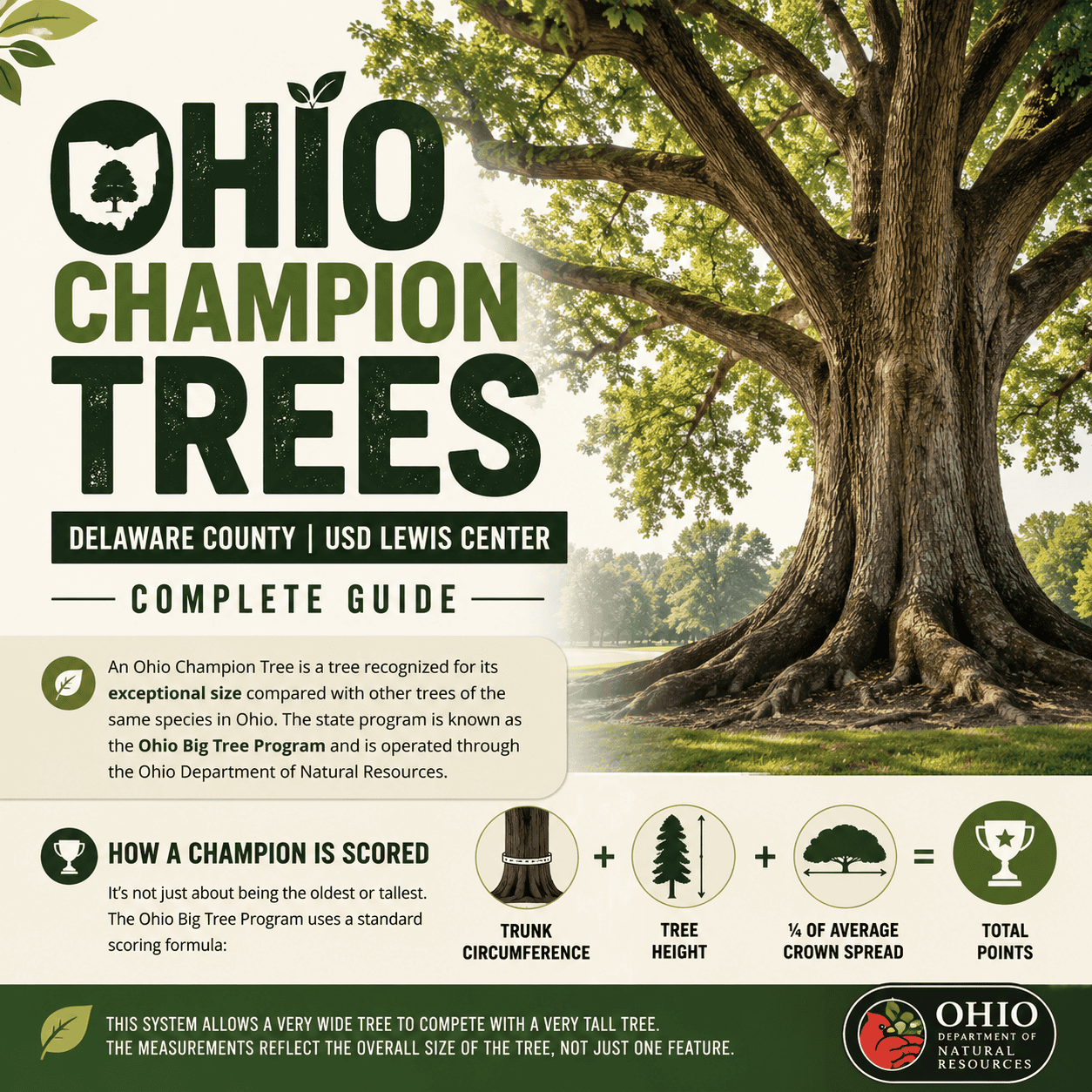
An Ohio Champion Tree is a tree recognized for its exceptional size compared with other trees of the same species in Ohio. The state program is known as the Ohio Big Tree Program and is operated through the Ohio Department of Natural Resources.
Being a champion does not simply mean that a tree is the oldest or tallest. The program uses several measurements to create a standard score.
The traditional scoring formula is:
Total points = trunk circumference + tree height + one-fourth of average crown spread
This system allows a very wide tree to compete with a very tall tree. The measurements therefore reflect the overall size of the specimen rather than just one feature.
How Ohio Champion Trees Are Measured
The measurement process is designed to make comparisons between trees more consistent.
| Measurement | What It Means |
|---|---|
| Trunk circumference | The circumference of the trunk measured at about 4.5 feet above the ground |
| Height | The total vertical height of the tree |
| Crown spread | The average width of the tree's canopy |
| Final score | Circumference + height + one-fourth of average crown spread |
A tree can therefore earn a strong score without being the tallest specimen in the state.
The system has also been used in local big tree competitions and identification projects across Ohio.
Why Delaware County Has Large Trees
Delaware County contains several landscape features that support mature tree growth. The Olentangy River, Alum Creek, wooded ravines, old agricultural properties, and protected parkland all provide suitable habitats for large trees.
The county's parks and natural areas preserve substantial woodland. Alum Creek State Park, for example, covers thousands of acres and includes forests, wildlife areas, trails, and water resources. County planning documents also identify wooded areas and mature natural habitats around the park.
The Alum Creek area is especially relevant to Lewis Center because the park extends through parts of southern Delaware County. A university field guide to the area also documents a broad selection of woody plants growing around Alum Creek State Park.
Champion Trees and Lewis Center
Lewis Center sits in an area where suburban development meets older woodland and river ecosystems. That combination makes the community and nearby countryside interesting for people studying large trees.
A documented Lower Olentangy River Watershed Inventory identifies champion-tree sites in and around Delaware County. Its records include a Black Walnut champion tree associated with the U.S. Route 23 corridor and a Bur Oak champion tree in Delaware County.
These records are important because they provide historical evidence of champion-class trees in the broader Delaware County landscape. They should not be treated as proof that every large tree currently standing in Lewis Center is still an official state champion. Champion rankings can change after new measurements, storms, tree loss, or the discovery of larger specimens.
Black Walnut Champion Trees in Delaware County
The Black Walnut is one of Ohio's best-known native hardwood species. It can develop a very large trunk and broad crown when it grows under favorable conditions.
The Lower Olentangy River Watershed Inventory identifies a Black Walnut champion tree in the Delaware County area along U.S. Route 23.
Black Walnut trees are also ecologically important. Their nuts provide food for wildlife, while mature trees contribute shade, habitat, and structural diversity to forests.
Because some large trees are on private property, visitors should not enter private land simply to inspect a suspected champion.
Bur Oak Champion Trees in Delaware County
The Bur Oak is another important native Ohio tree. It is known for its large leaves, thick branches, durable wood, and ability to live for a long time.
Historical watershed records identify a Bur Oak champion tree in Delaware County. The same documentation connects the area with major natural resources and mature woodland.
Bur Oak is particularly interesting for big tree hunters because mature specimens can develop both substantial trunk circumference and wide crowns. Those characteristics can produce a high champion score.
Alum Creek State Park and Big Trees
Alum Creek State Park is one of the most useful public areas for understanding the natural environment around Lewis Center and southern Delaware County.
The park contains forests and other natural habitats, and its woodland vegetation includes numerous native and non-native woody species. Ohio State's Woody Plants of Ohio field material identifies the Lewis Center area of Alum Creek State Park as a location for studying tree species.
Large trees are especially likely to develop around waterways and protected forest edges because these locations can offer:
Reliable water availability
Deep or productive soils
Reduced disturbance
Long periods of uninterrupted growth
However, the presence of a very large tree in a park does not automatically mean that it is an official Ohio Champion Tree.
Highbanks Metro Park and Mature Forests
Highbanks Metro Park is another important natural area near Lewis Center. It protects mature forest, river-related habitat, ravines, and other natural features along the Olentangy River.
The Lower Olentangy River watershed records identify Highbanks as an important natural location within the regional watershed.
Preservation of mature woodland is significant because trees need many decades to reach exceptional dimensions. Once an old tree is removed, replacing its ecological function can take a very long time.
Visitors can explore public trails at Highbanks, but they should stay on designated routes and follow current park rules.
What Does “USD” Mean in This Search Phrase?
The phrase “Ohio Champion Trees Delaware County USD Lewis Center” appears to combine several search terms rather than identify an official tree program, park, or government designation.
The established geographic references are:
| Term | Meaning |
|---|---|
| Ohio Champion Trees | Large tree specimens recognized through Ohio's big tree system |
| Delaware County | The county in central Ohio containing Lewis Center and several major natural areas |
| Lewis Center | A community in southern Delaware County |
| USD | Not identified in the official Ohio tree sources as a special champion-tree designation |
For accurate research, the key terms are Ohio Big Tree Program, Delaware County, Lewis Center, Alum Creek, and Highbanks.
Also Read: Vanderburgh Recent Bookings | Latest Arrests, Inmate Records & Updates
How to Find a Champion Tree Near Lewis Center
Finding a possible champion begins with identifying unusually large trees. A practical approach is to look in areas with old woodland, river corridors, historic properties, and protected land.
Check Mature Natural Areas
Public parks and preserved landscapes are good starting points because trees have greater opportunities to survive for long periods.
Important areas include:
Alum Creek State Park
Highbanks Metro Park
Preservation Parks of Delaware County
Olentangy River corridors
Delaware County's Char-Mar Ridge Park, for example, contains mature woods with oak, beech, maple, and hickory trees.
Identify the Tree Species
Accurate species identification is essential. Champion rankings are based on comparisons between trees of the same species.
Common large native trees in central Ohio include:
White Oak
Bur Oak
Black Walnut
American Sycamore
Tulip Tree
Silver Maple
Cottonwood
A tree that looks huge may still not qualify because its species has naturally smaller dimensions than another species.
Measure the Trunk
Use a measuring tape to determine the trunk circumference at the standard measurement point, normally around 4.5 feet above the ground.
The tree should be assessed carefully when the trunk has unusual swelling, multiple stems, or irregular growth.
For potential official nominations, use the current measurement instructions provided by the Ohio Big Tree Program rather than relying on informal measurements.
Measure Tree Height
Tree height can be measured with appropriate forestry equipment or reliable professional methods.
A visual estimate is not enough for official ranking.
Measure the Crown Spread
Measure the canopy in several directions and calculate the average spread.
This matters because the scoring formula gives one-fourth of the average crown spread a place in the final score.
Are All Large Trees Official Champion Trees?
No.
A tree can be enormous without being a registered state champion.
There are several reasons:
A larger specimen may exist somewhere else in Ohio.
The existing champion may not have been recently remeasured.
A tree may be locally famous but not officially nominated.
The tree may be on private property.
Historical records may describe a former champion that no longer holds the title.
This distinction is important when researching Ohio Champion Trees in Delaware County and Lewis Center.
State Champion vs National Champion
A state champion is the leading documented tree of its species within the state under the applicable program.
A national champion is the leading documented specimen for that species across the United States within the national program.
Ohio has participated in the national champion tree system, and its state program is associated with the Ohio Department of Natural Resources.
The two designations should not be used interchangeably.
A tree may be a large and impressive local specimen, a state champion, a co-champion, or a national champion.
Why Champion Trees Matter
Champion trees are valuable for more than their size.
Wildlife Habitat
Large trees provide nesting sites, cavities, bark habitat, flowers, seeds, nuts, and shelter for many organisms.
Carbon Storage
Older and larger trees contain substantial amounts of stored carbon in their trunks, branches, roots, and surrounding soil.
Water Protection
Trees along waterways can help stabilize soil, slow runoff, and provide shade to streams and rivers.
Education
Champion trees provide practical examples for teaching botany, forestry, ecology, measurement, and conservation.
Local Natural Heritage
Large old trees can remain visible reminders of landscapes that existed before modern development.
Local horticultural education programs in Delaware County have used champion trees to teach residents how tree size is evaluated.
Can Champion Trees Be Visited?
Some can be viewed in public areas, while others may be located on private land or in places where access is restricted.
Public parks such as Alum Creek State Park and Highbanks Metro Park provide opportunities to explore mature woodland without trespassing. Delaware County's visitor information lists hiking and other outdoor activities at Alum Creek State Park.
A specific tree should only be approached when its location is publicly accessible and the land manager permits visitation.
Never cross a fence, enter a private yard, or leave a restricted trail to reach a suspected champion.
How to Nominate a Potential Ohio Champion Tree
Ohio's Big Tree Program is described as a voluntary effort to locate, measure, record, and appreciate the largest tree species in the state.
A person who discovers a very large tree can begin by:
Identifying the species accurately
Recording the tree's location
Taking standard measurements
Documenting the tree with photographs
Checking the current Ohio champion records
Submitting the required information through the state program
Historical Ohio guidance also shows that members of the public have played an important role in locating potential big trees.
Important Safety and Access Rules
Tree hunting should be done responsibly.
Do not climb a suspected champion tree.
Do not enter private property without permission.
Stay on marked park trails unless an area is officially open for off-trail access.
Avoid damaging bark, roots, branches, or surrounding vegetation.
Do not approach trees during severe weather.
Follow all current park and preserve regulations.
A champion designation is a recognition of tree size. It does not automatically create legal protection for the tree. Delaware County Master Gardener education materials specifically note that official champion status by itself does not protect a tree from removal or other impacts.
Also Read: Why Is Fivebpeol Trending? Meaning, Platform, Features, and More
Frequently Asked Questions
Are there Ohio Champion Trees in Delaware County?
Yes. Historical and regional records document champion trees in Delaware County, including references to Black Walnut and Bur Oak specimens.
Is Lewis Center home to official Ohio Champion Trees?
The Lewis Center area is associated with significant mature forests and large tree habitats, but individual champion status should be confirmed against the current Ohio Big Tree Program records before a specific tree is described as an official state champion.
What is the best place to look for big trees near Lewis Center?
Alum Creek State Park, Highbanks Metro Park, river corridors, and other protected woodland areas are logical places to look for mature trees.
What makes a tree an Ohio Champion?
The tree earns a high score based on trunk circumference, height, and average crown spread compared with other trees of the same species.
Does a champion tree have to be very old?
No. Age is not the main scoring requirement. A fast-growing species can become exceptionally large without being as old as a slower-growing tree.
Can a tree lose champion status?
Yes. A tree can lose its position if another specimen receives a higher score, if measurements change, or if the original tree dies or is significantly damaged.
Can people nominate big trees?
Yes. Ohio's program is designed in part to encourage the public to locate and report exceptionally large trees.
Is every giant tree near Lewis Center a champion tree?
No. A very large tree may be champion-size or locally notable without appearing as the current official state champion.
Key Facts About Ohio Champion Trees in Delaware County
| Fact | Details |
|---|---|
| State program | Ohio Big Tree Program |
| State agency | Ohio Department of Natural Resources |
| Main measurements | Circumference, height, crown spread |
| Major local landscape | Olentangy River and Alum Creek areas |
| Important public natural areas | Alum Creek State Park and Highbanks Metro Park |
| Documented Delaware County champion species | Black Walnut and Bur Oak appear in watershed records |
| Best verification method | Check the current official Ohio champion-tree records |
| Access | Depends on whether the tree is on public or private land |
The most reliable way to verify a specific Ohio Champion Tree near Lewis Center is to compare its species, location, measurements, and current status with the latest information maintained by the Ohio Department of Natural Resources. The state's program is the authoritative source for Ohio champion status, while local park and watershed records provide useful information about the area's broader tree heritage.