

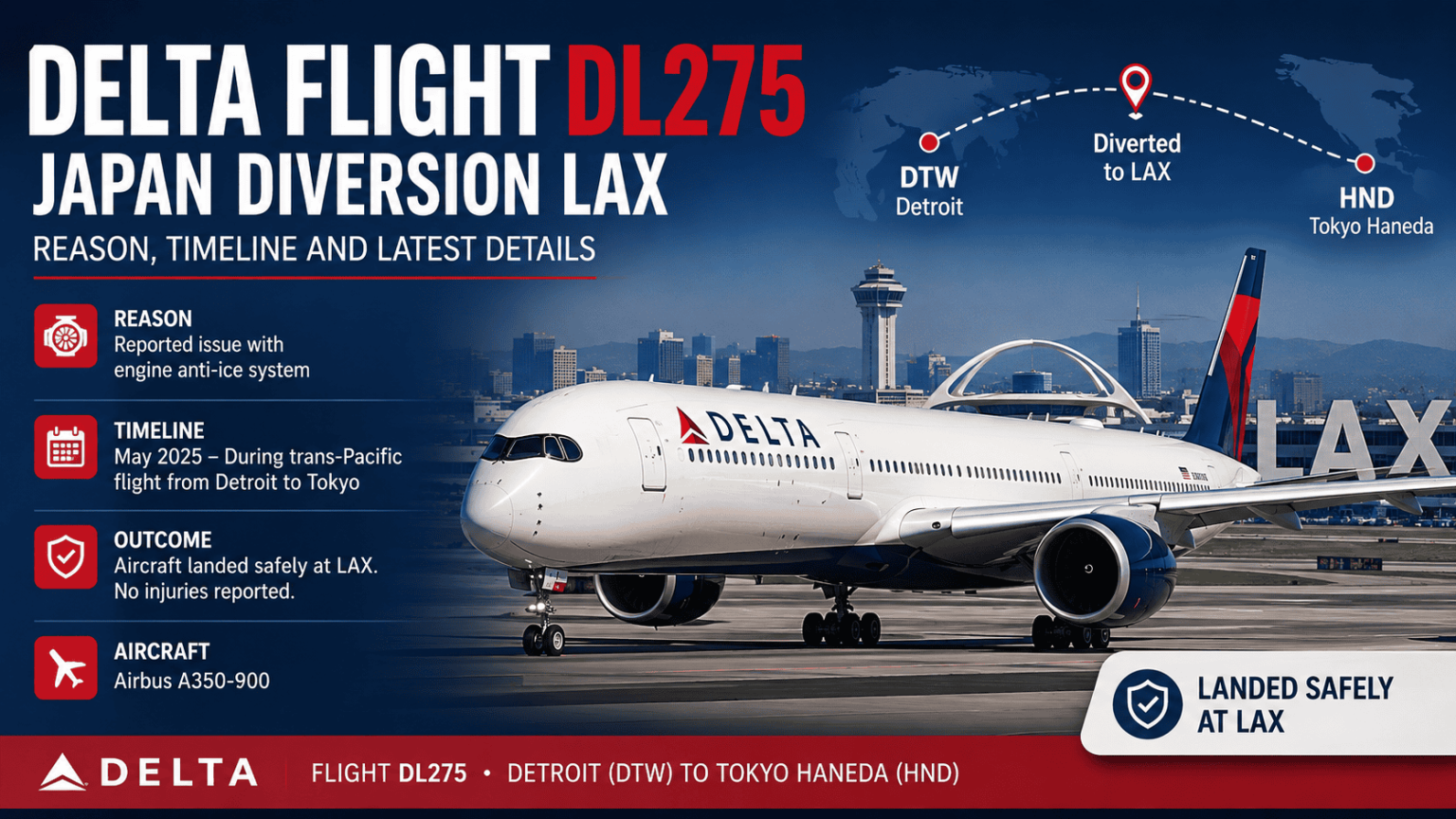
Delta Flight DL275, flying from Detroit to Tokyo Haneda, diverted to Los Angeles International Airport (LAX) during a trans-Pacific trip in May 2025 after a reported problem with an engine anti-ice system. The Airbus A350-900 landed safely, and the aircraft later returned to service.
Delta Flight DL275 Diversion at a Glance
| Detail | Information |
|---|---|
| Airline | Delta Air Lines |
| Flight | DL275 |
| Planned route | Detroit (DTW) to Tokyo Haneda (HND) |
| Diversion airport | Los Angeles International Airport (LAX) |
| Aircraft | Airbus A350-900 |
| Registration | N508DN |
| Reported technical issue | Engine anti-ice system problem |
| Flight position | About 620 nautical miles southwest of Anchorage |
| Cruising altitude | About FL380, or 38,000 feet |
| Landing runway | LAX Runway 06R |
| Landing result | Safe landing |
| Passenger injuries reported | None reported |
| Aircraft ground time after landing | About 18.5 hours |
The core details are supported by aviation incident reporting and flight tracking data.
What Happened to Delta Flight DL275?
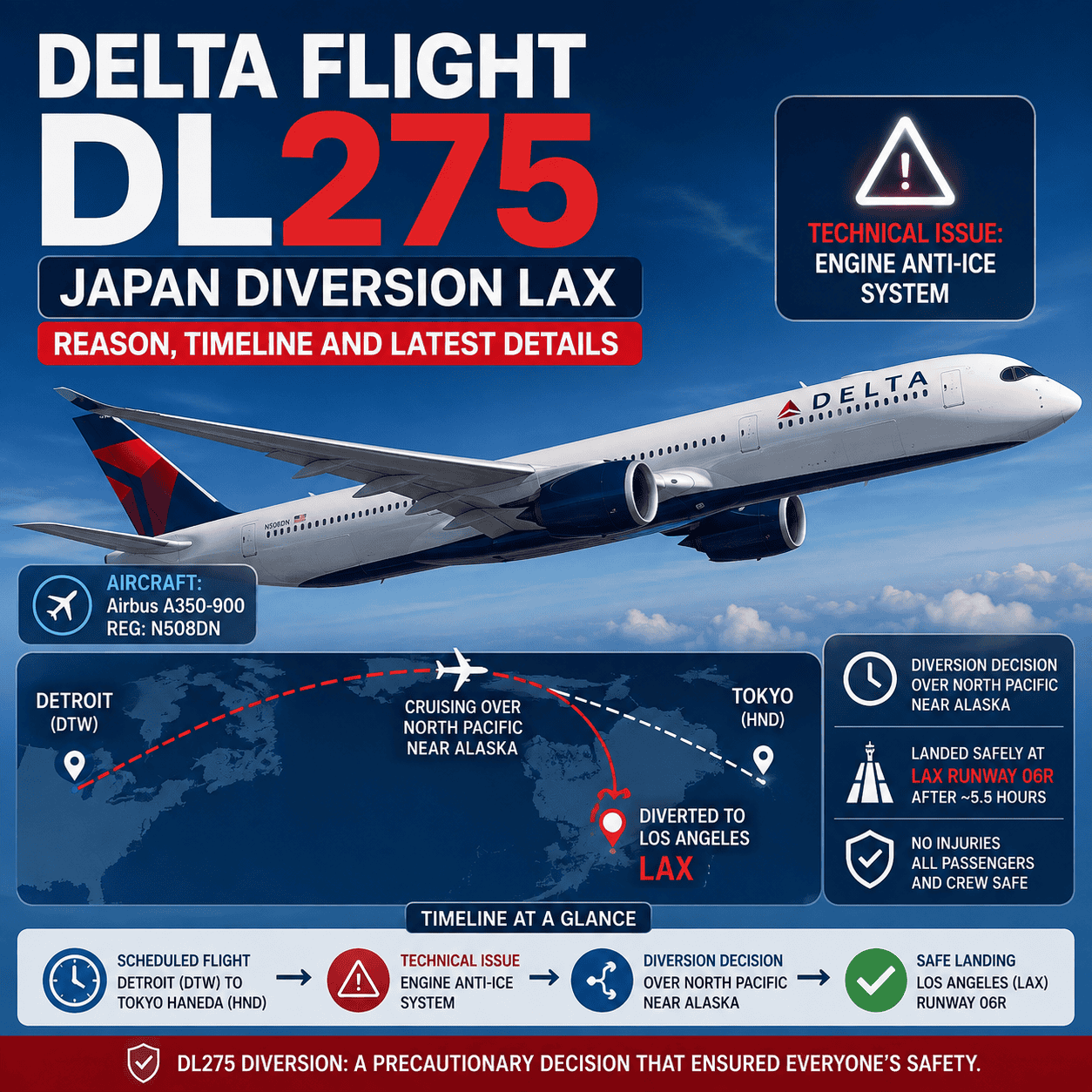
Delta Flight DL275 was operating its scheduled Detroit to Tokyo Haneda service on an Airbus A350-900. During the flight, the aircraft was cruising over the North Pacific near Alaska when the crew encountered a technical problem associated with the aircraft's engine anti-ice system.
The aircraft was identified as N508DN. Reports placed it at approximately 38,000 feet and around 620 nautical miles southwest of Anchorage, Alaska, when the crew decided to change course.
Instead of continuing toward Japan, the pilots diverted toward Los Angeles. The aircraft later landed safely on Runway 06R at LAX, about 5.5 hours after the diversion decision.
The unusual route attracted attention because DL275 was Tokyo-bound but ended up in California. However, the incident was a diversion caused by a technical issue, not a crash or loss of aircraft control.
Why Was Delta Flight DL275 Diverted to LAX?
The reported reason was a problem involving an engine anti-ice system on one of the aircraft's Rolls-Royce Trent XWB engines. Passengers reportedly heard an announcement about the engine anti-ice system during the flight.
An engine anti-ice system is designed to help protect parts of an aircraft engine from ice accumulation during operations in very cold conditions. This function is particularly relevant during high-altitude flight through cold atmospheric conditions.
A problem with such a system does not automatically mean that an aircraft is in immediate danger. It can, however, become an important operational concern on a long flight over remote areas. The crew must consider the aircraft's condition, the remaining route, available airports and maintenance support.
In the case of DL275, the pilots chose to divert rather than continue across the Pacific toward Tokyo. Available reporting indicates that this decision was made as a precautionary safety measure.
Also Read: WATE TV Knoxville News | Today’s Local News & Weather Updates
Why Did DL275 Fly All the Way to Los Angeles?
The choice of LAX can appear unusual because the aircraft was heading toward Japan. However, a diversion airport is not always selected simply because it is geographically closest.
Los Angeles International Airport is a major international airport and an important Delta operational location. It also has facilities capable of supporting large long-haul aircraft such as the Airbus A350.
Reporting on the incident states that the aircraft was redirected to LAX and subsequently remained there for approximately 18.5 hours before returning to service.
This ground time indicates that the aircraft required maintenance attention and operational checks before it could resume normal service.
The decision to divert should therefore be viewed in terms of safety, aircraft capability, airport suitability and maintenance support, rather than distance alone.
Delta Flight DL275 Timeline
Departure From Detroit
Delta DL275 began its scheduled Detroit to Tokyo Haneda journey on May 27, 2025, based on the local date at the departure airport.
The aircraft used for the flight was an Airbus A350-900, registration N508DN. Flight tracking records identify the same aircraft as the one involved in the diversion.
Technical Problem During the Flight
Several hours into the journey, the aircraft was operating over the North Pacific, near the Bering Sea and Alaska region.
The crew encountered the reported engine anti-ice system problem while the aircraft was at approximately FL380.
Diversion Decision
After assessing the situation, the crew changed the aircraft's planned route and headed toward Los Angeles International Airport.
This changed the flight from its original Detroit to Tokyo operation into an unscheduled Detroit to LAX diversion.
Arrival at LAX
The aircraft landed safely on Runway 06R at LAX approximately 5.5 hours after the diversion decision. No passenger injuries were reported in the available incident coverage.
Passenger Rebooking
After the aircraft arrived in Los Angeles, the original DL275 service was cancelled for the remainder of its scheduled journey to Tokyo.
Passengers were rebooked onto other flights to continue their travel.
Aircraft Returns to Service
The aircraft remained on the ground at LAX for about 18.5 hours before returning to operational service.
Was Delta Flight DL275 in an Emergency?
The word "emergency" can cause confusion when discussing airline diversions.
A technical problem can lead to a diversion without meaning that the aircraft is about to crash or that passengers are in immediate danger. Airline crews are trained to make conservative decisions when a system develops an abnormal condition.
For DL275, the aircraft remained controllable and ultimately completed a safe landing at LAX. The available incident reporting does not indicate a crash, loss of control or passenger injuries.
The decision to divert was therefore an example of preventive aviation safety management. The crew did not need to wait for the problem to become more serious before choosing another airport.
What Aircraft Was Used on DL275?
The aircraft involved was an Airbus A350-900, one of the wide-body aircraft used by Delta for long-distance international operations.
The registration was N508DN. Incident reporting identifies the aircraft as an A350-900 powered by Rolls-Royce Trent XWB engines.
Flight tracking records also show that N508DN continued operating Delta services after the 2025 incident. More recent tracking data shows the aircraft operating international flights, including DL275 between Detroit and Tokyo, confirming that it was not permanently removed from service.
What Happened to the Aircraft After the Diversion?
After landing at LAX, the aircraft remained on the ground for roughly 18.5 hours.
The long ground period is consistent with the need for technical inspection, maintenance and operational clearance following the reported anti-ice system problem. Available reports confirm that the aircraft eventually returned to service.
Later flight tracking records show N508DN operating normally, including service on the Detroit to Tokyo Haneda route in 2026. For example, the aircraft was recorded operating DL275 on July 26, 2026, from Detroit to Tokyo.
Did DL275 Continue to Tokyo From Los Angeles?
No.
The original DL275 flight was cancelled after the diversion, and passengers were rebooked on alternative flights to reach Tokyo and continue their journeys.
That means the aircraft did not simply land at LAX, complete a short technical check and continue the same flight number to Tokyo Haneda.
What Was the Reported Engine Problem?
The reported technical issue involved the anti-ice system associated with a Rolls-Royce Trent XWB engine.
The anti-ice system has an important role during flight in very cold atmospheric conditions. A malfunction can create an operational concern because the crew must consider the aircraft's ability to continue safely through the remaining route.
It is important to distinguish a system malfunction from a complete engine failure. The available reporting describes an anti-ice system issue, not a complete loss of engine power.
Was Anyone Injured on Delta Flight DL275?
Available incident reports state that the aircraft landed safely and do not report passenger injuries connected with the diversion.
The main passenger impact was travel disruption. Because the flight ended in Los Angeles instead of Tokyo, travelers had to be rebooked onto other services.
Why the DL275 Diversion Created Confusion Online
The incident created confusion because some online pages later presented the event as though it were a new 2026 diversion.
That is not supported by current flight tracking data.
The LAX diversion involving N508DN happened in May 2025. The flight number DL275 continues to operate as a scheduled Detroit to Tokyo service, so current searches for "DL275" can show normal 2026 flights alongside historical information about the 2025 diversion.
There was also another DL275 diversion in March 2026, when a later flight was diverted to Anchorage. That was a separate event and should not be confused with the May 2025 diversion to LAX.
Latest Status of Delta Flight DL275
The May 2025 LAX diversion is a past incident. Current flight tracking shows that DL275 remains an active Delta route between Detroit and Tokyo Haneda.
Flight tracking records from July and August 2026 show DL275 continuing to operate on the DTW to HND route, with different Airbus A350 aircraft assigned to the service on different days.
The aircraft involved in the 2025 diversion, N508DN, also returned to normal airline operations. Recent tracking data shows it operating international Delta flights and completing another DL275 Detroit to Tokyo flight on July 26, 2026.
Key Facts About the DL275 Japan Diversion
Delta Flight DL275 was originally traveling from Detroit Metropolitan Wayne County Airport to Tokyo Haneda Airport.
The aircraft was an Airbus A350-900, registration N508DN.
The reported technical issue involved an engine anti-ice system.
The aircraft was flying at approximately 38,000 feet near the North Pacific and southwest of Anchorage when the diversion decision was made.
The flight was redirected to Los Angeles International Airport.
The aircraft landed safely on Runway 06R after approximately 5.5 hours of diversion flight.
The original service was cancelled after arrival at LAX, and passengers were rebooked.
The aircraft remained at LAX for roughly 18.5 hours before returning to service.
As of August 2026, DL275 continues to operate between Detroit and Tokyo, and the aircraft involved in the 2025 event has also returned to active service.
Also Read: WREG TV Memphis Tennessee | Breaking News, Weather & Sports
Frequently Asked Questions About Delta Flight DL275
Why did Delta Flight DL275 divert to LAX?
DL275 diverted to Los Angeles because of a reported problem with an aircraft engine's anti-ice system. The crew chose to divert rather than continue the long trans-Pacific flight to Tokyo.
When did the DL275 LAX diversion happen?
The incident occurred in late May 2025, with the flight operating from Detroit on May 27 local time and reaching LAX during the early hours of May 28 local time. Some aviation databases use different dates because of UTC reporting and time-zone differences.
Where was DL275 when it diverted?
The aircraft was reported at approximately FL380, about 620 nautical miles southwest of Anchorage, Alaska, when the crew diverted toward Los Angeles.
Did Delta Flight DL275 crash?
No. The aircraft landed safely at LAX, and available reports do not indicate a crash or passenger injuries from the incident.
What happened to passengers after landing at LAX?
The original flight was cancelled, and affected travelers were rebooked onto other flights to continue toward Tokyo.
Is Delta Flight DL275 still operating?
Yes. Current flight tracking shows DL275 continuing to operate between Detroit and Tokyo Haneda in 2026.
What happened to the Airbus A350 involved in the diversion?
The aircraft, N508DN, returned to service after remaining on the ground in Los Angeles for about 18.5 hours. Recent flight records show it continuing to operate Delta international services.
Is the 2025 LAX diversion the same as the March 2026 DL275 diversion to Anchorage?
No. They were separate incidents. The LAX event occurred in May 2025, while a later DL275 flight diverted to Anchorage in March 2026.