

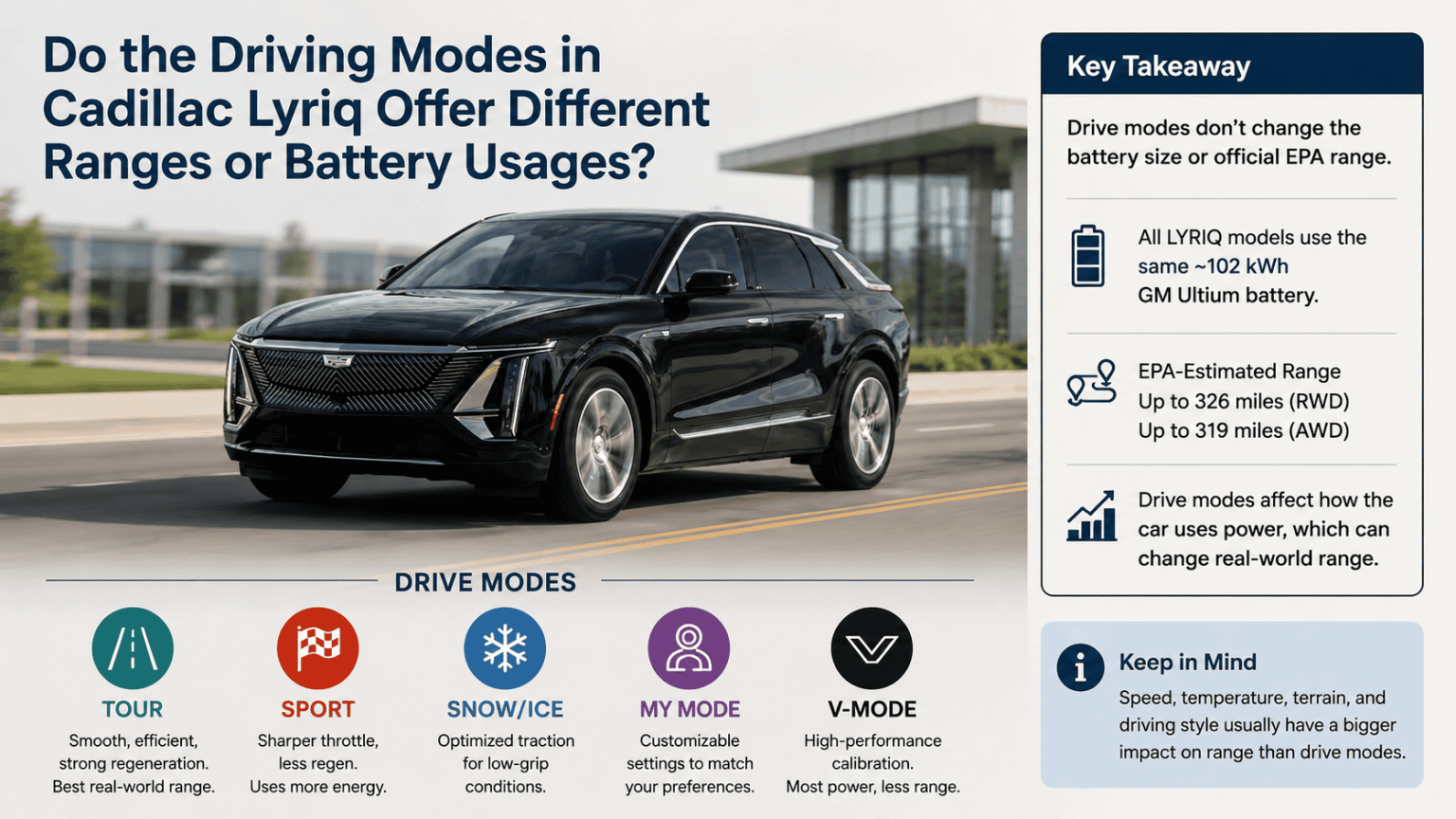
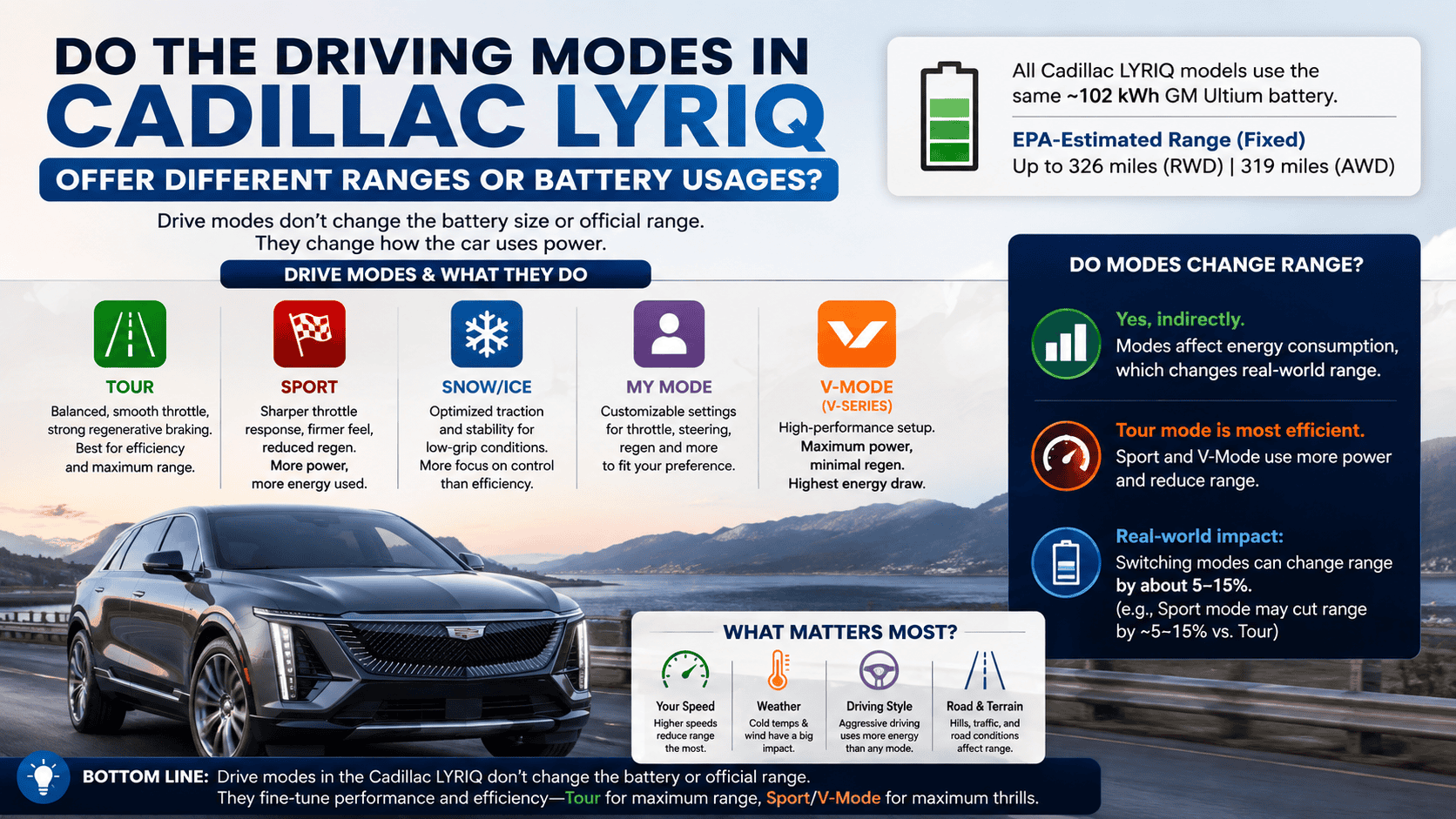
The Cadillac Lyriq’s drive modes do not change the battery’s size or official capacity – they only alter how the car uses power. All LYRIQ models use the same ~102 kWh GM Ultium battery, so the EPA-estimated range (up to 326 miles for RWD, 319 mi AWD) is fixed. However, drive modes (Tour, Sport, Snow/Ice, My Mode, and high-performance V‑Mode) adjust throttle response, steering feel, and traction control. These settings indirectly affect energy consumption and thus real-world range. In practice, the Tour mode (smooth throttle, strong regeneration) tends to yield the best efficiency, while Sport/V‑Max modes (sharper throttle, less regen) draw more power. Real-world tests and owner data suggest mode changes can shift range on the order of a few percent (e.g. Sport mode may cut range by ~5–15% compared to Tour). Other factors like speed, weather, and driving style usually have an even bigger impact on range than the mode itself.
The Cadillac LYRIQ is offered in multiple drive modes. Tour (default) is tuned for comfort and efficiency, while Sport sharpens throttle response. All modes use the same 102 kWh Ultium battery.

Overview of Cadillac Lyriq Drive Modes
Cadillac’s official documentation lists these primary LYRIQ modes: Tour/Normal, Sport, Snow/Ice, and My Mode (customizable). On performance-oriented V‑Series LYRIQs there’s also a Velocity Max (V‑Mode) for short bursts of power. In simple terms, Tour Mode is the default “smooth ride” setting, with normal acceleration mapping and a comfortable steering feel. Sport Mode firms up steering and throttle for quicker response. Snow/Ice Mode softens throttle mapping and adjusts torque distribution to improve traction on slippery roads. My Mode lets drivers personalize steering effort, braking feel, throttle map, and even motor sound. These modes are designed to match driving conditions or driver preference, not to change how much battery charge is available.
Cadillac’s own quick-start guide emphasizes performance and traction (tow/haul, AWD, off-road, etc.) when describing modes. It does not mention any mode altering battery chemistry or capacity – instead Tour is said to “optimize fuel economy” (i.e. efficiency) and Sport to provide a “sportier performance”. In practice, choosing a mode simply updates the car’s control settings. For example, Cadillac notes that no drive mode changes the Lyriq’s actual battery capacity – only how fast it’s consumed.
Battery and Range Basics
The Lyriq’s battery is a 102.0 kWh liquid-cooled Ultium pack. Under ideal conditions, EPA ratings (for 2026 models) list up to 326 miles (single-motor RWD) or 319 miles (dual-motor AWD) on a full charge. (The Lyriq-V, with 615 hp, is rated about 285 mi.) Real-world tests vary: for example, Car and Driver found the base RWD Lyriq achieved about 270 mi in a 75 mph highway test (vs. EPA 314 mi for older models). Their AWD test hit only 220 mi, illustrating how speed and conditions matter.
The key point is this: no drive mode changes these baseline figures. Whether in Tour or Sport, the battery’s energy content is constant. But modes tune the car’s throttle and regenerative braking settings, which changes how quickly that energy is used. In other words, the efficiency in each mode can differ. Below, we summarize each mode’s focus and its estimated effect on efficiency and range:
| Mode | Description (official) | Efficiency Impact | Approx. Range (base ~326 mi) |
|---|---|---|---|
| Tour Mode | Everyday driving: “normal acceleration and comfortable ride” tuning. | Highest (baseline) efficiency (strong regen). | ≈326 mi EPA (≈255 mi at 70 mph in one owner test). Best for maximizing range. |
| Sport Mode | Sporty settings: “tightened steering” and quicker throttle. | Slightly less efficient; owners report ~5–15% worse than Tour. Regen is reduced. | ≈265–280 mi. Useful for dynamic driving or merges, but will use more energy. |
| Snow/Ice Mode | Winter traction: “slows acceleration and torque response” to prevent slip. | ~3–8% less efficient than Tour. (System works harder to prevent wheelspin.) | Slight drop in range; cold weather itself can trim ~15–25%. Use on slippery roads only. |
| My Mode (Custom) | Driver-customizable: adjust steering, throttle, suspension, etc.. | Variable – can match Tour-like or Sport-like behavior. | ~265–326 mi, depending on settings. If set “soft,” range ≈Tour; if “hard,” ≈Sport. |
| Velocity Max / V‑Mode | Performance burst (V-Series): unlocks full power, adjusted cooling, etc.. | Significant drop if used continuously (no regen emphasis). | Much lower range. Cadillac warns only short bursts; expect range to plummet if used aggressively. |
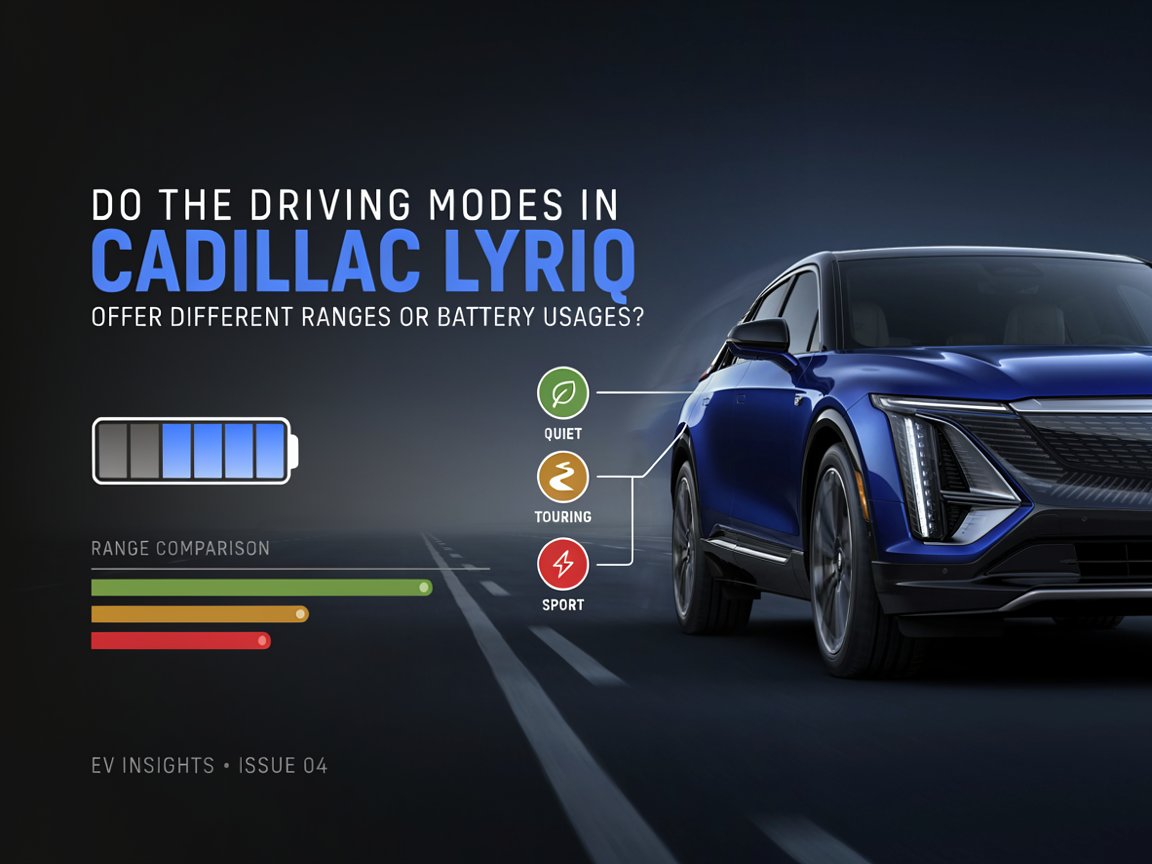
Each estimate above comes from owner reports and tests, since Cadillac does not publish mode-specific figures. Still, these make clear that Tour Mode (“smooth”) generally provides the best mileage, while Sport/V‑Mode (“lively”) sacrifices some range for performance. For instance, one owner logged about 2.5 mi/kWh (≈255 mi) at 70 mph in Tour Mode, but only 2.1 mi/kWh (≈219 mi) in Sport Mode. In practical terms, Sport Mode might cost you on the order of 5–15% of range if you drive aggressively, whereas Tour Mode’s gentler mapping helps conserve charge. (My Mode can emulate either – if you dial in Sport-like settings, its efficiency aligns with Sport mode.)
How Driving Modes Affect Range
In summary: driving modes adjust power delivery, not capacity. Cadillac’s official materials make this clear. For example, Simplesmarthub’s guide emphasizes that selecting Tour, Sport or Snow/Ice “there is no actual change of battery capacity, only a change in the control settings”. In other words, once you begin driving, you have the same total energy available – the car only changes how fast you use it.
Independent reports support this. A Cadillac owners’ survey noted that only about 1% of range complaints cited Sport Mode as the cause, while factors like wheel size, speed, and cold weather were far more common culprits. Owners also share that Tour Mode tends to yield steadier efficiency. According to one analysis, Tour delivers roughly 16–19% better efficiency than Sport at highway speeds, which translated to 50–60 miles more on a 326-mi battery. Sport Mode’s shaper throttle simply invites more energy use. Snow/Ice Mode shows about a 3–8% efficiency drop (plus the usual winter losses). V‑Mode brings a warning: Cadillac explicitly notes that prolonged use “will reduce range”.
Key Takeaways for Drivers: Tour Mode is generally the “sweet spot” for maximum range and efficiency. Sport Mode and Velocity Max are there when you want power, but you’ll pay in higher kWh consumption. Snow/Ice Mode is important for traction, not economy, and in dry conditions it’s actually less efficient. My Mode simply personalizes the behavior; its impact on range is whatever you make it (smooth settings = Tour-like range; aggressive = Sport-like range).
Also Read: NewAnonIB: Website Overview, History, Safety and Risks in 2026
Factors Beyond Drive Mode
It’s also crucial to recognize that road conditions and driver habits usually outweigh mode effects. High speed and weather swings can dwarf the few-percent range differences between modes. For example, Car and Driver’s test shows a Lyriq’s range fell from the EPA 314 mi down to 270 mi at a steady 75 mph, long before considering mode. Pushing the car faster will drain the battery much quicker. Likewise, cold temperatures can cut range by 15–25% (even ~45% in extreme cold) because battery chemistry slows and cabin heaters consume power. Tall wheels and rough terrain also reduce efficiency: owners report 22‑inch wheels cost about 3–5% of range. In fact, one Lyriq custom calculator notes that “temperature and speed alone can swing your real range by more than 100 miles”.
In practice, Lyriq owners say they seldom pin range issues on the drive mode. Forum discussions reveal drivers more often blame highway speed or winter weather, not Sport Mode. A 20°F day can slash range 30–40% regardless of mode. It’s always worth remembering: the Lyriq’s EPA number is based on a fixed test cycle in default mode. Anything from the weather to cruise control settings to tire pressure can trim that number in real life.
That said, using the most efficient mode you need still helps. Consistent use of regeneration (one-pedal driving, regen paddle) in any mode can recover energy on deceleration. Avoiding sudden, hard accelerations (especially in Sport Mode) will mitigate its extra drain. But overall, driving smoothly and moderating speed yield far more range gain than obsessing over mode swaps. As one summary puts it: “Driving style and weather have a greater impact on range than the selected driving mode”.
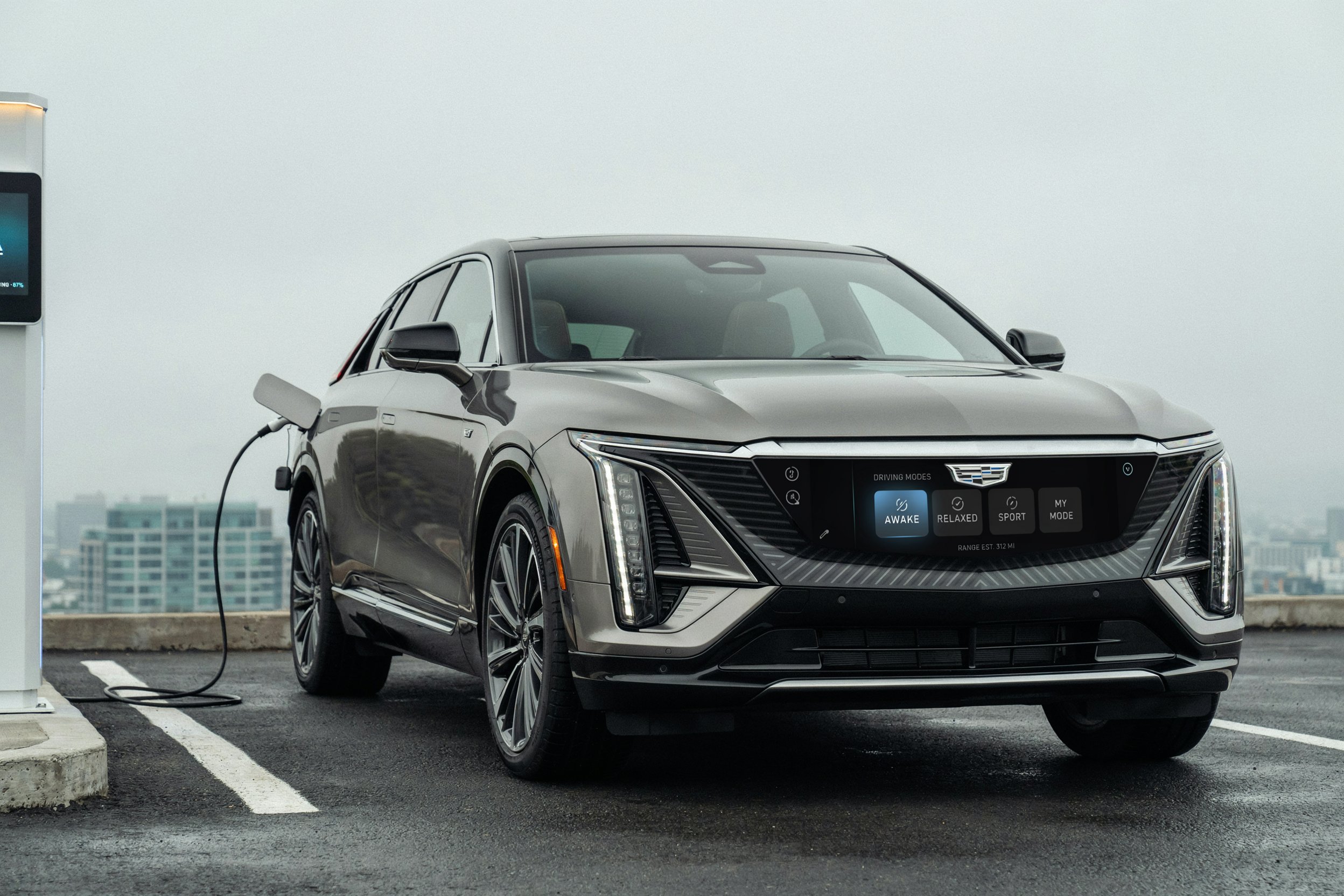
The Lyriq’s one-pedal driving and “Regen on Demand” paddle let drivers recover energy under braking. This feature is available in all modes and can help offset some range losses. (Image: Lyriq charging at a station, illustrating its electric drivetrain.)
Maximizing Range in Practice
Here are some practical pointers based on official info and real-world experience:
- Use Tour Mode for Economy. For routine commuting or long highway trips, Tour Mode is best for range. It softens throttle mapping and applies strong regen by default, so the battery drains more slowly.
- Reserve Sport Mode for Power. Switch to Sport Mode only when you want sharper acceleration or handling. Even then, drive moderately. If you mash the throttle often, you’ll see the range drop by roughly 5–15%. Remember you can always select My Mode (below) or toggle Sport on and off as needed.
- Snow/Ice for Slippery Conditions. Use Snow/Ice Mode only when roads are really slick. On dry roads it hurts efficiency. In winter, the biggest range hit is from cold itself and cabin heating, so pre-heating while plugged in and using eco-mode heating can help.
- Customize with My Mode. If you like aspects of Sport but not all of it, build a My Mode profile. For example, set a “soft” throttle and light steering in My Mode to mimic Tour mode’s efficiency, or a “hard” throttle with comfortable steering for a Sport-like feel. My Mode doesn’t magically add power – energy use will follow however you set it. Use it to create a balance you like, knowing that efficiency depends on those choices.
- Mind Your Speed and Driving Style. Regardless of mode, avoid high speeds and aggressive acceleration. One Lyriq user notes smooth driving can improve efficiency noticeably. At highway speeds, even in Tour mode, the Lyriq will fall short of EPA range (as the Car and Driver 270 mi test shows). Keeping to moderate speeds and gentle throttle will usually save far more energy than any mode swap.
- Take Advantage of Regeneration. Always use one-pedal driving or the regen paddle to capture braking energy. Tour mode already uses strong regen, but you can engage it manually in Sport as well. This recaptured energy extends your range on every drive.
In short, drive modes are tools to match conditions. They tweak the Lyriq’s behavior – Tour for relaxed efficiency, Sport for zest – but none of them “boost” the battery itself. Use the mode that fits the road and your needs, and remember that slow steady driving in Tour mode will stretch the miles the furthest.
For More: PedroVazPaulo Business Consultant | Services, Expertise & Business Growth
FAQ: Lyriq Drive Modes and Range
Does switching to Sport Mode reduce the Lyriq’s range?
Not by itself. Sport Mode gives quicker throttle response, which can encourage heavier acceleration. If you drive aggressively in Sport, you’ll burn more energy – owners report seeing a 5–15% range drop at highway speeds compared to Tour. But if you keep your foot light, Sport won’t magically drain the battery. In other words, Sport mode can shorten range if used heavily, but it does not shrink the battery.
Is Tour Mode the most efficient setting?
Yes. Tour Mode is tuned for everyday driving and comfort, and it normally offers the best real-world efficiency. It uses a gentle throttle map and strong regeneration. Cadillacs experts say Tour Mode “optimizes fuel economy” (i.e. efficiency). In tests, Tour has consistently delivered the longest distances on a charge.
Does Snow/Ice Mode hurt the battery’s range?
Only indirectly. Snow/Ice Mode softens throttle to prevent wheelspin. It itself is not a heavy drain – in fact, traction control can slightly increase draw, so owners estimate a few percent worse efficiency (around 3–8%). The real culprit in winter is cold weather. Battery efficiency drops at low temperatures and heaters run on grid power, often slashing range 15–25% or more. So if your range plummets in winter, it’s mainly the weather, not the mode.
What does My Mode (Custom) do to range?
My Mode itself has no fixed effect – it depends on how you configure it. The custom settings determine energy use: a soft throttle/steering setup in My Mode will be as efficient as Tour mode, whereas aggressive settings will mimic Sport mode’s draw. In other words, My Mode just lets you tailor the driving feel; your range will follow accordingly. It doesn’t add power, nor does it save energy by default.
Which factor affects Lyriq range more than drive mode?
Many factors. In fact, things like speed, weather, wheel size, and driving style are generally far more important than whether you’re in Tour or Sport. A Lyriq’s range falls dramatically at high speeds (one test saw 270 mi at 75 mph vs EPA 314). Cold temperatures can slash range by 15–25% (or more). Even tire pressure and added drag (bikes on a rack, etc.) can alter range. So always focus first on smooth driving and efficient habits – drive mode is just one piece of the puzzle.
Sources: Cadillac’s official guides and Quick Start materials describe the mode behaviors, while owner surveys and expert tests provide the efficiency estimates. All data above is based on current model information and real-world reports.
Also Read: CnLawBlog Explained | Origins, Content, and Credibility