

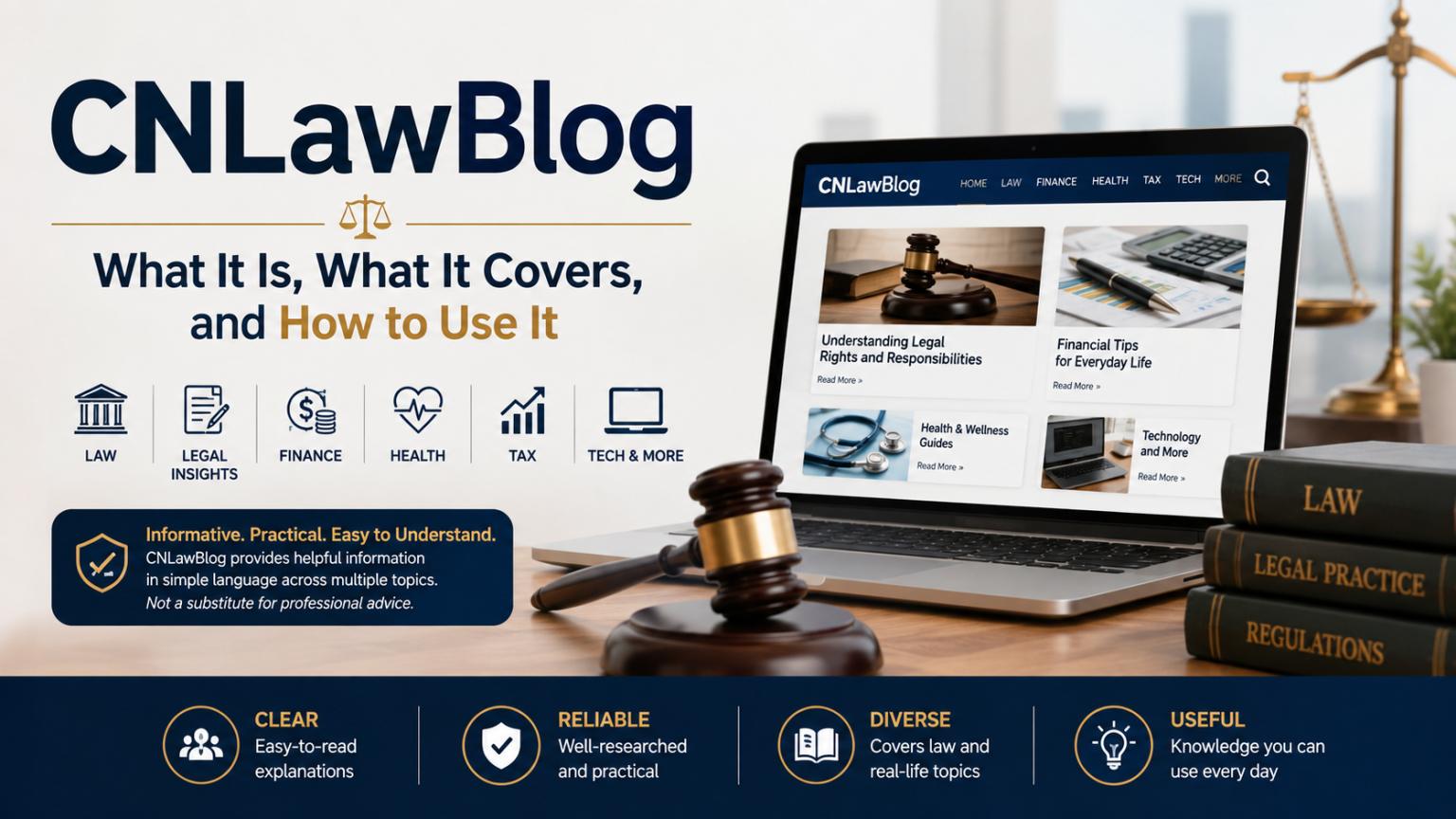
CNLawBlog is an independent digital publication at CNLawBlog.com that provides informational content across law and several other practical topics. It is designed to explain subjects in accessible language, but its own disclaimer makes clear that its articles are not a substitute for professional legal, financial, medical, tax, or other specialized advice.
The name can be confusing because several websites and publications use similar terms. In particular, CNLawBlog.com should not automatically be confused with the long-running China Law Blog published by Harris Sliwoski and associated with attorney Dan Harris. The two have different publishers, websites, and stated purposes.
What Is CNLawBlog?
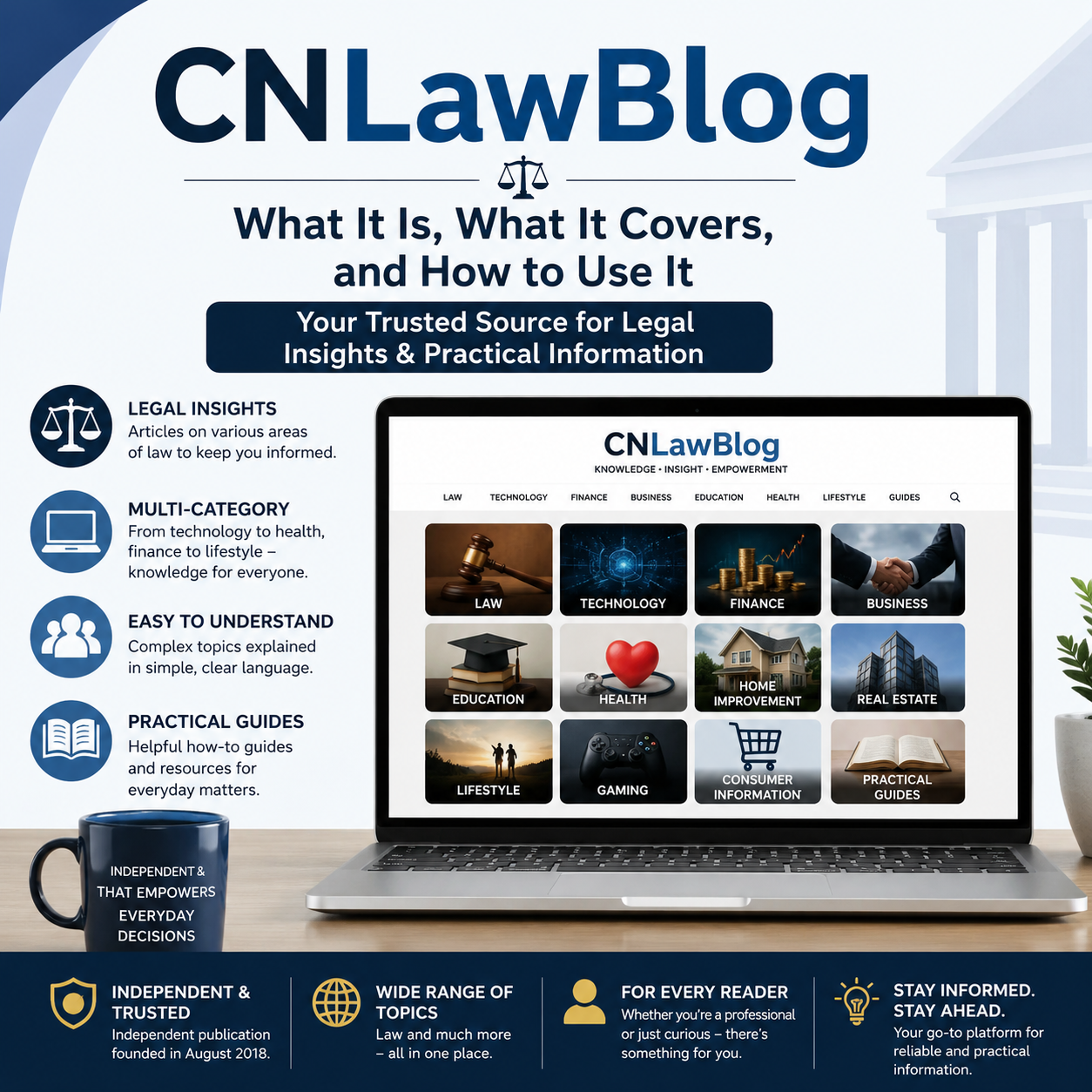
CNLawBlog.com describes itself as an independent online publication focused on making complex subjects easier for ordinary readers to understand. According to its About page, the publication says it was founded in August 2018 and has developed from a legal-oriented publication into a broader knowledge platform.
Its current coverage extends well beyond law. The website lists categories including law, technology, finance, business, education, health, home improvement, real estate, lifestyle, gaming, consumer information, and practical guides. Its navigation also includes legal subcategories such as accident law, civil law, corporate law, criminal law, family law, and personal injury law.
That means the most accurate way to describe CNLawBlog today is not simply as a traditional law journal. It is better understood as a multi-category digital information site with a significant legal section.
What Does CNLawBlog Cover?
The site's stated mission is to make useful information accessible to readers with different levels of knowledge. Its editorial material is organized around practical explanations rather than highly technical academic writing.
Its legal coverage includes several major areas.
Civil and Personal Injury Law
These sections address subjects that may be relevant to people dealing with accidents, injuries, insurance questions, wrongful-death matters, and related legal issues. The current site, for example, lists articles dealing with fire-damage insurance claims, wrongful death and serious injury representation, forceps delivery injuries, and personal injury lawyer marketing.
Readers should treat these articles as general background information rather than individualized legal guidance. The site's disclaimer specifically says that legal decisions should be made with the assistance of an appropriately qualified professional when personal circumstances are involved.
Corporate and Business Law
CNLawBlog also includes business-oriented legal topics. Its stated legal categories include corporate law, while its wider editorial coverage includes business and entrepreneurship.
This combination can be useful for readers who want a basic understanding of legal concepts connected to business operations, compliance, responsibilities, and commercial decision-making. It should not, however, be treated as a replacement for a lawyer reviewing a company's specific situation.
Criminal and Family Law
The website's legal navigation includes both criminal law and family law, suggesting that its legal section is intended to cover both personal and procedural topics rather than focusing on one narrow area of practice.
These subjects are particularly sensitive because laws and procedures vary significantly by jurisdiction. A general article can explain concepts, but readers facing an active criminal investigation, custody matter, divorce, or similar proceeding generally need advice that takes local law and individual facts into account.
Legal Updates and General Legal Education
CNLawBlog says its purpose is to explain legal information in a clear and structured way. Its own CNLawBlog guide describes its intended audience as including students, professionals, entrepreneurs, and general readers.
This makes the site more useful as an introductory research resource than as a definitive legal authority.
Is CNLawBlog a Law Firm?
No. CNLawBlog.com presents itself as an independent digital publication, not as a law firm.
Its disclaimer says the information published on the site is for general informational and educational purposes and does not create a professional, legal, advisory, fiduciary, or client relationship between readers and the site's owners, editors, contributors, or affiliates.
This distinction matters. A legal blog can explain a legal concept without providing legal representation. Readers should therefore avoid interpreting an article as an attorney-client communication or as an opinion prepared for their individual circumstances.
Is CNLawBlog an Official Legal Source?
CNLawBlog itself states that CNLawBlog.com is the official website of the CNLawBlog digital publication. Its FAQ says that original articles, editorial policies, and publication updates are published on that domain.
That statement establishes the site's own position about its identity, but it does not make the website a government authority, court, regulatory agency, or official source of law.
That distinction is especially important when researching legal questions. A blog article may summarize legislation or legal principles, but the controlling authority could instead be a statute, regulation, court decision, government agency publication, or other primary legal source.
For high-stakes decisions, the safest approach is to use CNLawBlog for context and then verify the underlying rule through the appropriate primary authority.
CNLawBlog vs. China Law Blog
One of the most important points for people searching for CNLawBlog is the difference between similarly named publications.
The China Law Blog is a separate publication associated with Harris Sliwoski and attorney Dan Harris. Harris Sliwoski describes it as a blog focused on the practical aspects of Chinese law and its effect on foreign businesses operating in or dealing with China. Its archive dates back to the blog's introduction in January 2006.
Dan Harris's official Harris Sliwoski biography also identifies him as the founder and principal writer of China Law Blog and notes the blog's recognition by the ABA Journal's Blawg Hall of Fame.
CNLawBlog.com, by comparison, describes itself as a broader independent digital publication covering numerous categories. It is not the same website simply because the names look similar.
| Publication | Main identity | Publisher or organization | Primary focus |
|---|---|---|---|
| CNLawBlog.com | Independent digital publication | CNLawBlog.com | Law plus technology, business, finance, education, lifestyle and other topics |
| China Law Blog | Established specialist law and business blog | Harris Sliwoski | Chinese law and doing business with or in China |
The distinction is important when following links, evaluating authors, or relying on a legal explanation. Searching only by a shortened name can easily lead to the wrong publication.
How CNLawBlog Organizes Its Content
The website uses categories to separate broad subject areas. Its main navigation currently lists technology, finance, business, education, health, lifestyle, real estate, and law, while the law section contains several narrower legal categories.
The site's own review describes this structure as a way of connecting related articles through categories, internal links, and search functionality. That can help readers move from a general concept to a more specific topic without starting a completely new search.
The homepage also demonstrates how broad the publication has become. Recent material includes subjects such as edge AI and data sovereignty, gaming, screen time, loan websites, bookkeeping, and home improvement, alongside legal articles.
That breadth is useful for a general information website, but it also means readers should pay close attention to the specific subject, author, date, and supporting sources of each article.
How Current Is CNLawBlog?
The website is actively publishing and updating material in 2026. Its homepage currently shows a July 2026 article on edge AI and data sovereignty, as well as articles published and updated earlier in 2026.
The site's FAQ says articles are reviewed and updated when important information changes or when improvements are needed. Its editorial policy also says published content may be updated to reflect changes in legislation, regulations, technology, industry standards, and other developments.
That is particularly relevant to legal content. Legal information can become outdated quickly, especially when regulations, court decisions, filing procedures, or statutory requirements change.
A publication date is therefore not enough by itself. Readers should also look for an update date and verify the current rule when the issue could affect money, legal rights, deadlines, compliance, or litigation.
Does CNLawBlog Have an Editorial Policy?
Yes. CNLawBlog has a published Editorial Policy explaining its stated approach to researching, reviewing, updating, and correcting content. The policy says the publication aims to make information clear, balanced, and useful and that readers can report factual inaccuracies or outdated information.
The policy also states that digital tools may assist with parts of the editorial workflow, such as research organization, drafting assistance, language refinement, grammar review, or content optimization. It says these tools do not replace editorial judgment and that content is subject to human review before publication.
For readers, the practical takeaway is that an editorial policy is a positive transparency feature, but a policy is not itself proof that every individual claim is correct. Strong legal research still requires checking important claims against primary sources.
Who Is CNLawBlog Useful For?
CNLawBlog can be useful for several types of readers, particularly those who need a starting point rather than a final professional opinion.
Students and Beginners
People with little legal background may find simplified explanations easier to understand than statutes, case reports, or highly technical legal articles. The site's stated mission specifically emphasizes accessible language and organized explanations.
For students, that can make the website useful as a secondary learning resource, especially when trying to understand a concept before reading more authoritative material.
Business Owners and Entrepreneurs
Business readers can use broad legal and business coverage to identify topics they may need to investigate further. This is particularly useful when a legal issue first appears as a practical business question.
However, important decisions involving contracts, employment, taxation, intellectual property, litigation, or regulatory compliance should still be reviewed using applicable primary sources and professional advice.
General Readers
For everyday readers, the site's plain-language approach can make unfamiliar terminology less intimidating. The website says its audience includes consumers, homeowners, professionals, researchers, and individuals who simply want to understand subjects affecting their personal or professional lives.
Is CNLawBlog Reliable?
The most balanced answer is that CNLawBlog can be useful as an informational resource, but its reliability should be assessed article by article.
The site has several transparency features that are worth noting. It publishes an About page, editorial policy, disclaimer, FAQ, and contact page. It also states that it accepts correction requests and reviews content when significant information changes.
At the same time, the site's own disclaimer expressly warns readers that information may become outdated and says readers should independently verify important information.
That warning should be taken seriously, particularly for legal topics. A well-written explanation is not necessarily the same thing as a primary legal authority.
How to Check a CNLawBlog Article Before Relying on It
A sensible verification process is more valuable than simply asking whether an entire website is "good" or "bad."
When reading a CNLawBlog article about an important legal issue, check:
- Publication and update dates. A legal rule may have changed since the article was written.
- Jurisdiction. A rule applying in Texas, California, England and Wales, or another jurisdiction may not apply where you live.
- Primary sources. Look for statutes, regulations, court opinions, government publications, or official agency guidance supporting the key claim.
- Author information. Determine whether the article identifies who wrote it and whether the subject requires specialist expertise.
- The article's scope. General educational material should not be mistaken for individualized legal advice.
- Conflicting information. When another authoritative source disagrees with a blog article, investigate the underlying authority rather than choosing whichever explanation sounds more convincing.
This process is especially important because CNLawBlog covers many jurisdictions and many different subjects. A general article can provide useful context while still leaving important questions unanswered.
Does CNLawBlog Make Money?
CNLawBlog's FAQ states that the website uses third-party advertising partners, including Google AdSense, to support the publication. It also says that some articles may contain affiliate links, through which the publication may earn a commission if a reader makes a purchase.
The presence of advertising or affiliate links does not automatically make information unreliable. What matters is whether commercial relationships are disclosed and whether editorial claims can be independently supported.
The site's editorial policy says sponsored, promotional, or partnership material is identified where applicable.
Readers should still distinguish between an editorial explanation and content created for promotional purposes.
Can You Submit a Guest Post to CNLawBlog?
Yes. CNLawBlog has a guest-post page inviting contributors to submit articles. Its stated requirements emphasize original, relevant, and informative material, while spammy, irrelevant, or harmful links are prohibited. The site also says submissions are manually reviewed before publication.
The site says contributors can submit material with author details and target links and that typical review times are described as 24 to 72 hours. It also states that affiliate links are not accepted under its stated guest-post rules.
For anyone considering publication on the site, the important point is that guest posting should be treated as a publishing opportunity rather than proof that every contributor is a legal authority.
How to Contact CNLawBlog
CNLawBlog provides a contact page for questions, corrections, guest articles, advertising, and business inquiries. The site publishes an editorial contact email on that page and also encourages readers to report errors or outdated information.
Its correction process is particularly relevant for legal content because a correction mechanism gives readers a way to flag information that may no longer be accurate.
What CNLawBlog Does Well
The platform has several useful characteristics for readers who want accessible information.
Clear organization is one of its strongest features. The site separates subjects into categories and provides dedicated legal sections, making it easier to browse related material.
Plain-language presentation is another major focus. CNLawBlog repeatedly describes its mission as simplifying complicated subjects, and its own review emphasizes structured articles that are accessible to people without specialist backgrounds.
Editorial transparency is also a positive. The website openly provides a disclaimer, editorial policy, FAQ, About page, contact information, and information about advertising and affiliate relationships.
Where Readers Should Be Cautious
The biggest limitation is not necessarily the website itself but the nature of online informational content.
A legal explanation can become outdated. A business article may apply only to one jurisdiction. A general health or finance article may omit personal factors that change the appropriate decision. CNLawBlog itself acknowledges these limitations in its disclaimer and advises readers to independently verify important information.
The site's own review also identifies areas where its content could become stronger, including deeper explanations, more case-based analysis, and greater advanced-topic coverage.
That makes CNLawBlog more suitable as a starting point for understanding a topic than as the final authority for consequential decisions.
Also Read: Coyyn.com | Digital Finance, Crypto & Online Money Guide
Final Assessment of CNLawBlog
CNLawBlog.com is best viewed as an independent, multi-topic digital publication with a substantial legal-content section rather than as a law firm, government legal database, or substitute for a lawyer. Its strengths are accessibility, broad subject coverage, organized navigation, and published editorial and disclosure policies.
Its legal articles can be useful for learning terminology, understanding broad concepts, and identifying questions that require further research. But readers dealing with actual legal rights, court proceedings, contracts, compliance obligations, or deadlines should verify important claims against primary legal sources and qualified professionals.
The name also deserves special attention. CNLawBlog.com is separate from the China Law Blog associated with Harris Sliwoski and Dan Harris, so readers should confirm the exact domain before assuming that two search results belong to the same publication.
Ultimately, the safest way to use CNLawBlog is straightforward: use it to understand, use authoritative sources to verify, and use qualified professionals for personalized advice.